Like strawberries crushed To sweeten marmalade A heart pained Is shred to bits Bitter sweet memories Ruddy peels in jelly mush Sitting still in fragile jars Lingering fragrance Myriad flavors on the lips Fingers now sticky with Soulful tales to spread!
Even in the blazing summer The world has frozen over Splattered with blood Of swindled innocents Loss of generations Unconsoled lamentations Our souls so cold Hearts so numb; When Gods are at war Men matter no more? Just marionettes, petty In the playbook of destiny!
Books were bought with care and cherished; not hoarded into digital spaces because someone recommended the next best-seller. Reading was not competition; it was relaxation.
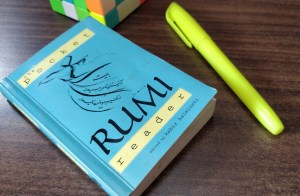
Rumi
I have a Rumi Pocketbook in my desk, since more than two decades, and once upon a time it gave me much succour. That was before the age of the madness of devices. It moved around with me one house to another, packed in boxes. Then, it lay quietly in a drawer, waiting, holding words of wisdom in it’s bosom, until my 11-year old son retrieved it and asked if it was age-appropriate for him to read! My heart overflowed with joy!
It is important to have books in the house – hardcovers, paperbacks; diaries, 📒 notebooks and stationery – little treasures, waiting to be discovered. Let your children unearth the bounty, find solace and refuge in the power of the written word. My son writes in his little Harry Potter themed journal or blogs only after jotting down ideas in a notebook. He loves glitter pens and gel pens, and no batch of bookmarks🔖 or post-it notes are ever enough. We share our love for stationery and to his credit I have introduced him to the indulgence. I blogged about this earlier also.
Quite a few stories are narrative in style, imageries piling up, increasingly reflecting the complexity of perceptions. Chan clearly questions, “Has the world always been like this, both insane and chaotic, only he has not seen it as it actually is until now?” This is the theme of the book. Anguished ponderings on the chaos in our minds, purpose, and meaning of our lives, as we try to find a place as friends, lovers, and social beings.
Nonchalant Man
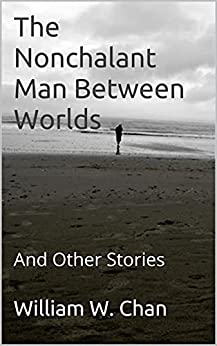
Book: The Nonchalant Man Between Worlds: And Other Stories
Author: William W. Chan
Genre: Fiction, Self-Discovery, Short Stories, Magical Realism
The first story in this collection by William W. Chan, reminded me of Oliver Sack’s work – The Man Who Mistook His Wife for a Hat. Deeper into the book, a Kafkaesque feeling emerged. It is the nature of man to always seek. Some seek answers in science, trying to decipher the mysterious functioning of the brain. Many lean towards metaphysical pondering on the functioning of the heart, soul, and mind.
The Nonchalant Man Between Worlds: And Other Stories are based on this quest, chasing the pertinent question of what’s real in our world and what may lie beyond in other realms. Dreams can be derived from realities and perturb us as much as illusions in waking hours.
The human and anti-human, creatures, demons, evil, fear, all emerge in our thought-scape based on the state of our mind. What happens when something snaps within us and cracks appear in our vision; when the mind is philosophical, the heart is lonely, and the soul disillusioned? Hallucination-based stories like those told by Chan are born.
Nightmares and illusions predominate the stories. Shifting perceptions harass the characters. My personal favorite is, The Fallen, where I sensed a mystery and indulged in a guessing game of who Harold was and his fate. Many of the open-ended stories leave us wondering.
Quite a few stories are narrative in styI can derive dreamsle, imageries piling up, increasingly reflecting the complexity of perceptions. Chan clearly questions, “Has the world always been like this, both insane and chaotic, only he has not seen it as it actually is until now?” This is the theme of the book. Anguished ponderings on the chaos in our minds, purpose, and meaning of our lives, as we try to find a place as friends, lovers, and social beings.
The well-articulated stories are for anyone who has an interest in metaphysical, spiritual, and philosophical notions, motifs, and themes. Interpretation and understanding of Magic Realism shifts from one reader to the next, in fact, one day to another. Such works are not for light readers.
This is a book for rumination and not just about people going about their daily lives. It is for readers who question the happenings and perceptions of their regular existence. It demands attention and offers deep contemplation dressed up as Magical Realism. Keep a highlighter handy for some musings that are worth marking for a later read, as you relate with them.
June 8, 2017 – Winding up our site-seeing, we reached our cosy hotel-with-a-view in Gangtok from Lachung in Sikkim. Our intent was to shop, laze around, relax in the night, devour a leisurely breakfast buffet the next morning, drive down back to Bagdogra, and fly back home in the evening. In Gangtok, we heard murmurs of violence in Darjeeling, West Bengal. An agitation was brewing against the alleged imposition of Bengali language on the locals.
We were advised to leave early the next day to catch our flight from Bagdogra. Later that evening, at MG Road, jam packed with tourists, the atmosphere was tense. People enquired about the proclaimed bandh on June 9, and asked if they should drive back to Bagdogra in the night, instead of the morning. Tourists queued up at ATMs. It was difficult to get into the narrow offices of any of the cab-services providers.



 Blue Pen Strokes