
Book Review: The Fragility of Light

A novel that poignantly delves into the complexities of generational trauma and its effects on mental health

The Fragility of Light – Book Cover

Book: The Fragility of Light

Author: Heather Lonczak

Genre: Contemporary fiction, Literary Fiction, Novels

Review copy: BookSirens

Available at: Amazon.in

Recommended: Must read

Trigger warning: Mental health, mental illness

A novel that poignantly delves into the complexities of generational trauma and its effects on mental health.

In Heather S. Lonczak’s contemporary novel, The Fragility of Light, generational trauma and the fragile state of mental health cast their shadows over the life of Sylvia “Sunny” Zielinski. Sunny’s picture-perfect introverted existence takes a harrowing turn when she starts experiencing psychotic episodes.

Lonczak masterfully portrays mental illness, but not before immersing us in the wholesome experiences of youth—promising careers, love in the air, and a wedding on the horizon. Through her poetic prose, Lonczak transports us to a world steeped in charm and nostalgia, where the scent of lilies mingles with sun-warmed tomatoes still clinging to the vine. Sunny’s encounter with Joshua ignites an idyllic love, and their future seems vibrant.

As Sunny introduces Joshua to her gentle and wholesome family, the foundations of their new life appear unshakable. Yet, lurking in the past are shadows that resurface tragically, rocking their boat. Cracks emerge, and the once sweet and tender narration takes on gray overtones, plunging Sunny and all who love her into a nerve-wracking deluge.

Lonczak intricately weaves Sunny’s story with the perspectives of Joshua and Peter, her father. Both men grapple with the heart-wrenching realization that the one they love dearly is suffering, yet they find themselves powerless to alleviate her pain. Lonczak’s portrayal of their struggle captures the complexities of love and helplessness in the face of mental illness. Despite the recurring nature of shared experiences in the storyline, delving into Joshua and Peter’s tribulations remains relevant. Both men must bear the consequences: Joshua faces a crumbling present, and the future appears fraught with fear. Meanwhile, Peter’s past wounds resurface, raw and bleeding. Their intertwined struggles provide essential context, revealing the impact of generational trauma on their lives.

Lonczak’s novel is crucial to comprehend the impact of grief-stricken depression and the role of genetics in mental health. In brief lucid moments, Sunny glimpses her downward spiral, but the psychotic episodes remain beyond her control. Within her fragile mind, she carries the storm of genetic and generational trauma, unable to prevent the destruction it unleashes.

Skillfully delving into the complexities of trauma and its lingering effects, Lonczak invites readers to discover whether Sunny can battle her demons and whether Joshua’s love and devotion can withstand the searing trial. This novel, with its close exploration of matters of the mind and heart, leaves a lasting impression. Fans of literary fiction will find much to admire in this thought-provoking and emotionally resonant work with strong writing.


I received an advance review copy for free from BookSirens and I am leaving this review voluntarily.
Book Review: Sober Thoughts from the Crazy House

The words flow, each better than the next, sometimes rhyming, sometimes like the churning of an ocean, thoughts dripping from every nook, every crevice. Each thought more relatable than the next, some philosophical, some mundane but the currents strong enough to wash you away.

Book: Sober Thoughts from the Crazy House

Author: J. Maxwell

Genre: Poetry, Self-Discovery

Review Copy: From the Author

Available on: Amazon.com

For Mental Health Awareness Month, I got the opportunity to read one of my favorite literary forms – poetry. J. Maxwell (Twitter @JMaxwell_Writer), author and illustrator’s debut poetry collection, Sober Thoughts from the Crazy House, is a candid evocation of his journey from mental health issues to a more sober approach to life.

One of the first steps to recovery, to solve issues permeating our lives, is to accept the situation and to seek help. J. Maxwell starts with the backstory of his struggles and how he overcame years of addiction and self-abuse. Words provided an artistic refuge. In searching for the words to express, Maxwell was seeking answers.

Many who have been lost and found their way will relate to the outpouring in the fluent verses. These words can be yours, mine – anyone who has grappled with self-doubt, self-disdain, guilt, shame, fear. You can imagine the poet scribbling on paper napkins and vagrant sheets, crumpled, torn at the edges, as he tries to find the meaning, define the terms in the textbook that are now a part of him. The anguish is palpable, yet with a glimmer of hope, for only those who seek shall receive.

The poems touch a vast array of experiences; hallucinations, anxiety, mania, depression, addiction, withdrawal, therapy. At a certain moment, I thought the formatting was juvenile, like children expanding alphabets to words in wordplay. However, each alphabet in Maxwell’s vocabulary dives into an intense experience with well-crafted interpretations. The words flow, each better than the next, sometimes rhyming, sometimes like the churning of an ocean, thoughts dripping from every nook, every crevice. Each thought more relatable than the next, some philosophical, some mundane but the currents strong enough to wash you away.

This is a book for those who can appreciate the beauty and depth of free verses. It can be perceived as a haven for the troubled mind, evolving from experiences in the “crazy house.” Maxwell’s poetic expressions are not only for those who want to know how they feel, how someone else in their position feels but also a must-have for caregivers and guides, for readers and learners. It is an insight into a mind filled with chaos, trying to find balance, all on its own, without reaching out for help.

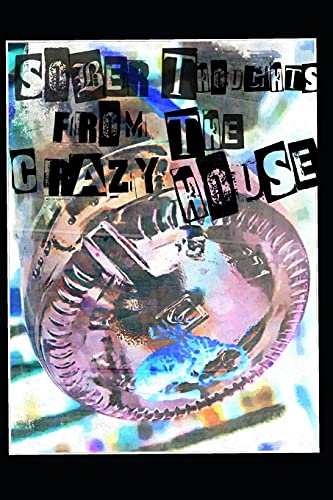
When troubled souls can’t articulate, the sober writings from the recovering mind can be a guidebook. I find this to be a precious collection that I would recommend everyone to read because where thoughts overburden us only words can be saviors. I would have liked to see some illustrations along with the words, making it an immersive experience. I also found it hard to decipher the book cover* art work and would like some insight into it.

*The author reached out to me with a note: “The cover art is the underside of the bottom of a bottle. This was perfect since so many go looking for answers at the bottom of a bottle only to find there aren’t any. You have to get to the bottom to really find that out though.”

J. Maxwell’s work speaks of hope, of finding yourself, and of repeating the message:

Don’t judge yourself

Lest ye cast the first stone!

Mind Matters

Whirling in my mind
A collective hallucination
Of spirits guiding me
Towards insanity
I blindly embrace
Sights and sounds
Of each murky thought

A part of me lingers
In the stale past
Seeking answers
From silhouettes
Melting in the mist
Far from sight
Never far from mind!

Delirium descends
On my tired mind
Chaos ascends
In my troubled heart
I crave for solace
In the labriynths
Of my raving madness

My mind blows
Dark dreams explode
Under the pressure
Contained for so long
Now floating free
Infecting the world
With smug audacity!

Narcissism

I am bound to you
In horrific ways
The Devil allures me
Evil sucks me in
Smoldering my senses
My memories reek of ashes
When a soul was liberated;
Dark, troubled, demanding
Now residing in you
In love with me!
In sweet elixir
Of sugar coated words
A bitter pill camouflaged;
In your love for me hides
Twisted fulfilment
Of a narcisstic mind!