

Book Review: Espresso with the Devil

Book: Espresso with the Devil

Author: Thomas Poppe

Genre: Fiction, Self-Discovery, New-Age

Review Copy: Reedsy

Available on: Amazon.in

Must Read!

A title as interesting as Espresso with the Devil keeps up to its promise of being an engrossing read. Tom, a writer, is approached at the airport by Fred, who introduces himself as the Devil. The Devil is worried and he needs Tom to carry his message to mankind. The premise reminds me of two popular renderings on modern television – Lucifer on Netflix and Crawley from Good Omens on Prime Video – and Fred seems as intriguing and entertaining as these televised characters.

Soon, the writer and Devil are engaged in contemporary discourse on the nature and purpose of modern life. The discussions elaborate how the Devil is able to allure humans to go against their basic instincts and indulge in complex and artificial living that exacerbates the struggles of humanity.

The onslaught of technology diminishes mental faculties. Ease, convenience leads to decay. As fake news, deep fake, permeate our lives, the conscientious can identify the perils of idolizing achievers and creating role models, without knowing the whole truth.

The discussion delves into the competition, materialism, commercialization, scientific and medical advancements, as concepts that imply success but actually are instruments of destruction. Harmony and equality perturb negative forces, hence, rivalry and envy are created in the Devil’s workshop.

The contemplation provides advice to free oneself of the rat race and reclaim the simplicity of a hard-working life for a fulfilling existence. Impulsiveness in thought and action, quick fixes, and striving for the luxurious lead to many of our daily and long-term problems. These are just some of the intriguing topics touched upon in this engrossing read.

The conversation is light, yet the message is deep. A book to be relished in one go and then picked up in moments of deliberation, making an impact one passage at a time. It is a self-help book but for humanity. It puts in words all our scattered thoughts on what is wrong with our world.

Practical insights, spiritual messages, anecdotes, and Devil Hacks may help us reset, recover, renew, or leave us wondering at the impending fate of humans. A book that makes one think is worth the time and attention. I am glad to have discovered it. It pulsates with the anguish of our modern lives and how we are in self-destruct mode. Is there a way to turn away from the abyss? Let the book reveal.

Book Review: A Million Things To Ask A Neuroscientist

Book: A Million Things To Ask A Neuroscientist: The brain made easy

Author: Mike Tranter

Genre: Teens and Young Adult (13+), Non-Fiction, Science, Neuroscience

Review Copy: Reedsy.com

Also available at: Amazon.in

When the first word in a book is as casual as OK, you wonder if it is of any merit. A quick walk into the preface and you realize the power of this book is in its simplicity. A deep-dive and you are engrossed in the complex world of the brain but in a fun way through this book.

A Million Things To Ask A Neuroscientist – the brain made easy is listed for ages 12+ but I would recommend it for at least Grade 9 and above. Written in a succinct style, it contains some scientific terms that may disengage a younger reader. For anyone into the basics of the science of the brain and fiery neurons filled with questions about how this super organ works and controls the human body, this is one fascinating read.

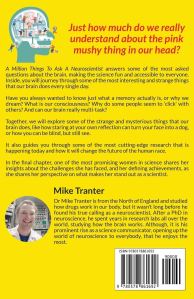
Mike Tranter, a neuroscientist from the UK, living in California, embellishes this book with some easy diagrams and a lucid style that maintains the depth of the subject but with an informal tone. Complex neuroscience mechanisms are explained with daily life examples. As an avid reader of books related to the brain and the unknown areas that are still waiting to be discovered or fully explained, I found this book to be informative and engaging. From learning about the brain-blood-barrier to the fact of neurogenesis, it draws you into the captivating world of grey and white matter.

The text centers on positive messaging, as it talks about the effect of drugs, addiction, withdrawals, depression, social coupling, the power of learning languages, and recovery after injuries, amongst other things. It is almost like being in an exciting classroom with an amazing teacher who brings the subject home.

The concepts discussed are as intriguing as the brain itself – from lucid dreaming to nightmares, dream incubation and dream prophecy, fear, memories, intelligence, to whether scientists understand how anesthesia works, to the question of whether memories can be transferred to a device using technology. It touches on esoteric aspects of consciousness, meditation, syndromes, and a pertinent query – are male and female brains different? This is just 2/3rd of the book content – there is more to learn and know – so grab a copy!

This book is a thrilling ride and literally food for thought. It does not answer all the teeming questions, for example, I wanted to know about migraines. Well, it is a book that deserves a sequel. The cover design is bright and inviting, and the content is worthy of your time and attention. For more insight, read Mike’s article on why and how he wrote this book.

Book Review: Sober Thoughts from the Crazy House

The words flow, each better than the next, sometimes rhyming, sometimes like the churning of an ocean, thoughts dripping from every nook, every crevice. Each thought more relatable than the next, some philosophical, some mundane but the currents strong enough to wash you away.

Book: Sober Thoughts from the Crazy House

Author: J. Maxwell

Genre: Poetry, Self-Discovery

Review Copy: From the Author

Available on: Amazon.com

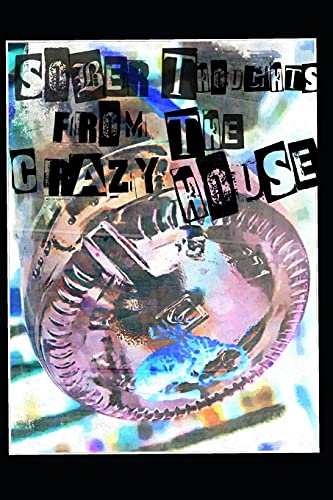
For Mental Health Awareness Month, I got the opportunity to read one of my favorite literary forms – poetry. J. Maxwell (Twitter @JMaxwell_Writer), author and illustrator’s debut poetry collection, Sober Thoughts from the Crazy House, is a candid evocation of his journey from mental health issues to a more sober approach to life.

One of the first steps to recovery, to solve issues permeating our lives, is to accept the situation and to seek help. J. Maxwell starts with the backstory of his struggles and how he overcame years of addiction and self-abuse. Words provided an artistic refuge. In searching for the words to express, Maxwell was seeking answers.

Many who have been lost and found their way will relate to the outpouring in the fluent verses. These words can be yours, mine – anyone who has grappled with self-doubt, self-disdain, guilt, shame, fear. You can imagine the poet scribbling on paper napkins and vagrant sheets, crumpled, torn at the edges, as he tries to find the meaning, define the terms in the textbook that are now a part of him. The anguish is palpable, yet with a glimmer of hope, for only those who seek shall receive.

The poems touch a vast array of experiences; hallucinations, anxiety, mania, depression, addiction, withdrawal, therapy. At a certain moment, I thought the formatting was juvenile, like children expanding alphabets to words in wordplay. However, each alphabet in Maxwell’s vocabulary dives into an intense experience with well-crafted interpretations. The words flow, each better than the next, sometimes rhyming, sometimes like the churning of an ocean, thoughts dripping from every nook, every crevice. Each thought more relatable than the next, some philosophical, some mundane but the currents strong enough to wash you away.

This is a book for those who can appreciate the beauty and depth of free verses. It can be perceived as a haven for the troubled mind, evolving from experiences in the “crazy house.” Maxwell’s poetic expressions are not only for those who want to know how they feel, how someone else in their position feels but also a must-have for caregivers and guides, for readers and learners. It is an insight into a mind filled with chaos, trying to find balance, all on its own, without reaching out for help.

When troubled souls can’t articulate, the sober writings from the recovering mind can be a guidebook. I find this to be a precious collection that I would recommend everyone to read because where thoughts overburden us only words can be saviors. I would have liked to see some illustrations along with the words, making it an immersive experience. I also found it hard to decipher the book cover* art work and would like some insight into it.

*The author reached out to me with a note: “The cover art is the underside of the bottom of a bottle. This was perfect since so many go looking for answers at the bottom of a bottle only to find there aren’t any. You have to get to the bottom to really find that out though.”

J. Maxwell’s work speaks of hope, of finding yourself, and of repeating the message:

Don’t judge yourself

Lest ye cast the first stone!

Reedsy Discovery – A Platform for Indie Publishing

Today, I started reading my first book in the Reedsy Discovery book review community. Reedsy is a British startup online author services firm promoting collaboration between authors and publishing freelancers in the self-publishing industry. Discovery, puts a spotlight on the best works of the Independent (indie) publishing world — great books that are often overshadowed by big bestsellers.

Reedsy

As a reviewer, I have full access to the Reedsy Discovery library of advanced review copies (ARCs) and other member perks. Hundreds of authors have submitted their books for discovery. I have access to the submissions pool and can read and review books before they launch.

I hope to guide the writing and reading community by spotting new trends and deciding which books Discovery recommends for its 200k readers. Not all writers get big publishing contracts, not all big house publications are great. A lot of talent lies in Indie publishing. I am privileged to help these writers in my own small way; I am proud to support independent publishing.

The Editorial Manager of this platform contacted me after reading my blog. My blog, in its previous avatar, and now with a new URL, has always brought me fantastic writing and reading opportunities. I am glad to read and review more books. I hope can identify some good work. As the Reedsy Discovery site for reviewers says: The best books go undiscovered, be part of the movement that shines a light on them.

I can write reviews as often as I like and they will appear in the Discovery newsletters to readers. I will also share book reviews on this blog. The first book I started reading today is an engaging story about magic in the life of a Creole girl. I am sure this will be an exciting journey.

Book Review: The Emperor who Vanished

The book has good font size, smooth language, and dives into anecdotes and information from history, art, and architecture. A great memory refresher for adults with a few new facts and a wonderful book to make the children interested in our rich history, monuments, and the wonders of ancient times! I recommend this book for 10 years and above readers and even as a bedtime read for younger children.

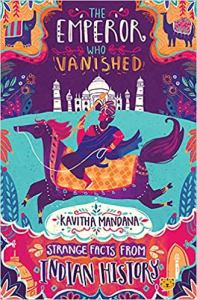
Now, that I am building my 11-year old son’s library, I am getting to read some great children’s/young adult fiction, and rediscovering forgotten facts. Kavitha Mandana’s The Emperor who Vanished is a book that introduces Indian history, art, and architecture in an interesting manner. This book is relevant for children in middle school because this is the time they are discovering more about India’s rich heritage and culture in their school curriculum.

The book has good font size, smooth language, and dives into anecdotes and information from history, art, and architecture. A great memory refresher for adults with a few additional facts and a wonderful book to make the children interested in our rich history, monuments, and the wonders of ancient times! I recommend this book for 10 years and above readers and even as a bedtime read for younger children.

Rating – 4/5. A star less because my son did not enjoy the fictional bit about the two students embarking on a school project. I also felt the language was not taut in those sections. The characters were not flushed out and the attempt to create a funny and engaging storyline was not exactly accomplished. Even without focussing on the story of Apu and Nina, the book is worth a read.