You are the book Nestled on my chest Heaving in deep sleep A story embedded In my thoughts, as I go About daily chores Impatient to trace Inquisitive finger tips On gravely carved scripts Turning over pages Revealing secrets That made me shudder In anticipation of none other But the distant momen when I will curl up with you in bed
The quiet I usually crave
Patiently waits for me
At the corner of my bed
A pillow carries perfume
Of freshly washed hair
Mildly stained sweet sweat
Of long summer nights
Wrinkled sheets beckon
Hiding a half-open book
And a peeping bookmark hints
It may well be time to rest
The quiet I usually crave Patiently waits for me At the corner of my bed Pillows carry perfume Of freshly washed hair Mildly stained with sweat Of long summer nights; Wrinkled sheets beckon Hiding a half-open book A peeping bookmark hints It may well be time to rest
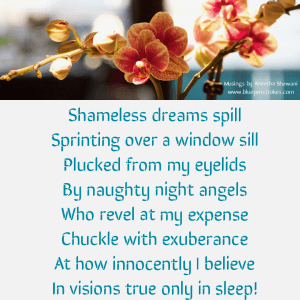
Shameless dreams spill Sprinting over a window sill Plucked from my eyelids By naughty night angels Who revel at my expense Chuckle with exuberance At how innocently I believe In visions true only in sleep!
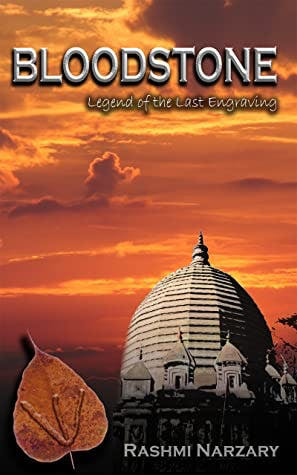
The book brings forth deep research and impeccable imagination. The author’s personal experiences come alive in descriptions of the Kamakhya temple rituals and the religious fervor during the autumn worship of the Goddess. The exotic yet demanding terrain of the hills of Nepal is the backdrop of the tale of a simple village couple that breaks free of the shackles of matriarchy to redefine their fate. It is the story of motherhood – earthly and divine – always alive in mythology, legends, but most importantly in human faith.
Author Rashmi Narzary entwines the fascinating customs of the Kamakhya temple in the Nilachal hills of Assam, India, with the spectacular tradition of the Kumari Goddess in Tilibham, Nepal. In a fictional story that blends mythology and history, legends and existing beliefs, she creates an intriguing narrative centered around the Mother Goddess in South Asian culture. Across the snowy climes of Tilibham, a story blossoms out of loss and yearning, and like any tale of utmost passion and longing, it stretches beyond time and space to remind of the power of sadness to change destinies. The plot arc curves over this canvas. Conflict brims even after 3/4rth of the narration. Anticipation of the resolution makes the book unputdownable.
The book brings forth deep research and impeccable imagination. The author’s personal experiences come alive in descriptions of the Kamakhya temple rituals and the religious fervor during the autumn worship of the Goddess. The exotic yet demanding terrain of the hills of Nepal is the backdrop of the tale of a simple village couple that breaks free of the shackles of matriarchy to redefine their fate. It is the story of motherhood – earthly and divine – always alive in mythology, legends, but most importantly, in human faith.
Is this book prophetic? Read what the author thinks.
BLoodSTONE: LEGEND OF THE LAST ENGRAVING
It is also the story of love that transcends eons – of God Shiva, who mourns his beloved Sati and a Goddess, who must be reborn to fulfill the yearning of divine lovers. The book will make you crave more. Like me, you may seek more information on the traditions so exquisitely detailed. Divinity dwells in humanity that incessantly seeks it out; humanity survives in a deep faith in this power of the esoteric.
As a reader, I was mesmerized by the story. As an editor, I found the book lacking. It starts with repetitive text and descriptions that can be discouraging. After initial reluctance, one forges ahead into the enticing landscape of a wondrous story. The script demands a thorough edit as the repetitive information is distracting. The book would have sparkled with a crisp and concise approach, leaving more for the reader to imagine and savor, long after, the legend of the bloodstone reveals itself.
Regrets, conflicts, defects From the mirror life reflects Images of what was Shadows of what wasn’t Reminder of what can be Fate plays on fleeting reels Surreal spectres, unreal dreams




 Blue Pen Strokes