

Book: Class Distinctions Thru History in Review: A Collection of Essays
Author: Stephen Joseph Scott
Genre: History, Non-fiction
Review copy: Author-provided
Available at: Amazon.in
Recommended: Good; Must read for history enthusiasts.
History, as we know it, is gargantuan concealing depths of knowledge that can only be revealed through dedicated research and thematic analysis. In Class Distinctions Thru History in Review: A Collection of Essays, Stephen Joseph Scott delves into the history of class hierarchies and politics, creating a concise handbook for students of World and American History.
With a strong background in history and impressive academic credentials, Scott explores multiple themes, supporting his narrative with numerous references and quotes. Broadly, he addresses:
- Class and race: Examining how socio-economic status and racial identity have shaped historical events and societal structures.
- Historical materialism: Analyzing history through the lens of class struggle and economic factors.
- Revolutionary perspectives: Highlighting the impact of revolutionary movements and figures such as Martin Luther King Jr. and Fidel Castro.
- Neo-Conservatism: Discussing the rise and influence of neo-conservative ideologies in the 20th century.
- Slavery and the founding of America: Addressing the complexities of America’s founding, including the institution of slavery.
Scott addresses sagas as old as civilization itself, illustrating how economic disparities continue to grow, with the rich getting richer while the poor struggle to make ends meet. The book emphasizes that, despite progress, racial injustice remains pervasive in society, even within the world’s strongest nations. Scott explores how economic factors shape social and political structures, driving the widening wealth gap that leads to dissatisfaction and dissent.
Both domestic and foreign policies often overlook class-based disparities, either ignoring the issues or furthering the interests of the powerful. These themes are intertwined with contemporary challenges, offering valuable insights into the complexities of modern society. Movements like Occupy Wall Street and ongoing debates about income inequality and racial discrimination are framed within a historical context, enriching our understanding of these pressing issues.
I particularly enjoyed Chapter 7: Ideology and Hypocrisy amid Slavery and Democracy, which investigates historical influences from Ancient Greece that have shaped modern social and economic structures. I was especially intrigued by how Scott dedicates a significant portion of a chapter to analyzing the award-winning movie Green Book. This analysis reflects on how class and racial identities impact our creative and artistic choices. Faced with oppressive politics, creative outlets like books, cinema, and art emerge as a subtle means of expressing discontent.
Chapter 9 presents another interesting essay, reviewing Where the Negroes Are Master by Randy J. Sparks. This work offers valuable insights into the African end of the Atlantic slave trade. Similarly, the analysis of the Preamble of the American Constitution is engaging, and additional essays prompt inquiries about “who benefitted from categorical constructs of race and class” and the “sins of democracy.” Overall, these chapters highlight the complex interplay between art, identity, and historical context in shaping our understanding of democracy and oppression.
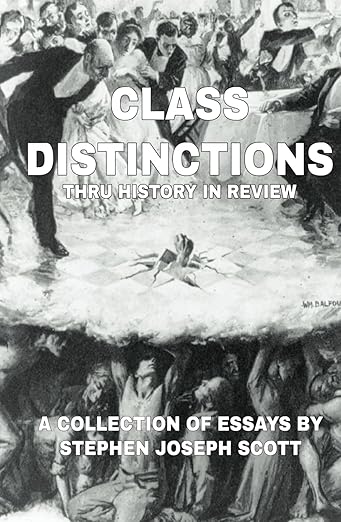
The black-and-white book cover visually encapsulates the theme of the work. The split design effectively contrasts the upper and lower classes, highlighting societal disparities throughout history. The juxtaposition of well-dressed individuals at a social gathering against the somber, crowded environment of the lower class powerfully conveys the book’s focus on social and historical analysis.
Overall, Class Distinctions Thru History in Review: A Collection of Essays is a valuable addition to historical and socio-economic literature. Scott’s insightful analysis and revolutionary perspectives make it a must-read for anyone interested in understanding the complex dynamics of class and race throughout history. However, the book could benefit from tighter line editing, as occasional editorial lapses and lengthy sentences may distract readers from the otherwise compelling narrative. The writing sometimes feels weighed down by the significant topics it addresses and the extensive research Scott frequently cites.
This academic collection of essays remains relevant today, critically examining historical events and figures while encouraging readers to reflect on the ongoing impact of class and race in contemporary society. Its strength lies in its ability to challenge traditional narratives and promote a deeper understanding of socio-economic dynamics. Scott’s in-depth work prompts readers to question the status quo and consider the broader implications of historical events.
I received a review copy, and I am leaving this review voluntarily.




 Blue Pen Strokes