Book Review: The Clock in My Mother’s House

Annalisa Crawford, through a collection of stories – The Clock in my Mother’s House – skillfully transports readers into a world where time bends, age defies conventional boundaries, and characters confront their inner demons.

The Clock in My Mother’s House – Book Cover

Book: The Clock in My Mother’s House

Author: Annalisa Crawford

Genre: Fiction, Short stories

Review copy: BookSirens

Available at: Amazon.in

Recommended: Must read

Short stories spanning a variety of themes and notions – some obtuse, some as real as they can be.

Annalisa Crawford, through a collection of stories – The Clock in my Mother’s House – skillfully transports readers into a world where time bends, age defies conventional boundaries, and characters confront their inner demons. “Your future isn’t fixed. It’s like an ocean, flowing in all directions, nothing’s settled until you’re much older.”

Her narratives blur the lines between reality and fantasy, inviting readers to delve into either mystical realms beyond comprehension or to contemplate the workings of the human mind. Each story is meticulously crafted, showcasing Crawford’s expertise in blending elements both mystical and real. For example, in All the Magpies Come Out to Play, she captures fear and hope during a pandemic. In two stories A Thousand Pieces of You and Click – she delves into intense emotions and the power of resilience.

Crawford’s writing style is captivating. Each story is imbued with possibility, inviting readers to immerse themselves in the layered narration and ponder the story’s direction. Even in the confines of a short story, the characters elicit the reader’s interest and empathy. Whether it’s a stormy night or a tranquil weekend, The Clock in My Mother’s House promises an immersive reading experience that stays with the reader long after the last page is turned.


I received an advance review copy for free from BookSirens and I am leaving this review voluntarily.

Book Review: Cat & The Dreamer

Mystery, melancholy, and a struggling protagonist in a novella that is a compelling read: Cat and the Dreamer by Annalisa Crawford

Cat and the Dreamer – Book Cover

Book: Cat & The Dreamer

Author: Annalisa Crawford

Genre: Fiction

Review copy: BookSirens

Available at: Amazon.in

Recommended: Must read

Trigger warning: Death, bullying

Mystery, melancholy, and a struggling protagonist in a novella that is a compelling read

Cat and the Dreamer by Annalisa Crawford is a captivating read that deftly intertwines elements of mystery and melancholy. Crawford’s writing style is exquisite, drawing readers in with its expressive prose and evocative descriptions. “My dreams are always vivid, lurid almost, like an over-exposed photo. It’s how I know what’s real. Reality is tinted with a disappointing grey pallor, washed out, even when the sun is shining and the sky is cobalt blue, or golden leaves are falling from the trees.”

One of the most compelling aspects of the book is Crawford’s character introduction and development. Readers are quickly drawn to Julie, the protagonist, intrigued by her mysterious aura. As an adult professional still living with her parents, her life circumstances pique interest. Julie is portrayed as self-conscious, burdened by the past, and experiencing waking dreams that blur the lines between illusion and reality, as she searches for “A Perfect Dream.”

Crawford expertly spins a storytelling web that captivates readers, keeping them engrossed until the very end. She presents a unique perspective through monologues, with references to the ‘cat’ that emphasize its wild traits over its typical feline cuteness. The book cover is a succinct portrayal of how Julie’s dreams are her escape portal.

Overall, Cat and the Dreamer is a slow-burn fiction that rewards readers with its engaging narrative and unfolding revelations. Crawford’s skillful writing and masterful storytelling make it a must-read for fans of literary fiction. The novel develops gradually, demanding the reader’s concentration, introspection, and appreciation of a poignant story told in a unique style. Importantly, the book sheds light on the complexities of adolescence, the impact of peer influence on young adults, and the burdens one can carry throughout life.


I received an advance review copy for free from BookSirens and I am leaving this review voluntarily.

Book Review: 30 Stories about Life & Death: Flash Fiction

An engaging collection of short stories, spanning geographies, cultures, experiences, and emotions.

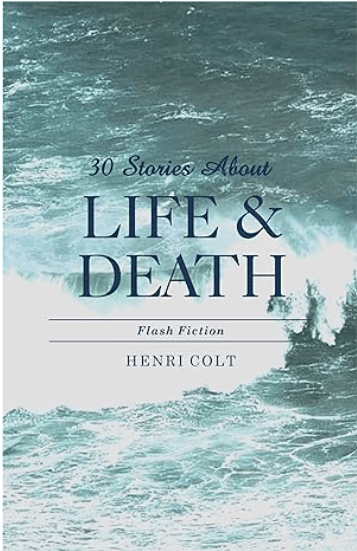
30 Stories about Life & Death: Flash Fiction – Book Cover

Book: 30 Stories about Life & Death: Flash Fiction

Author: Henri Colt

Genre: Fiction, Flash fiction

Review copy: Reedsy

Available at: Amazon.in

Recommended: Must read

An engaging collection of short stories, spanning geographies, cultures, experiences, and emotions.

Brevity in storytelling is a commendable trait. Henri Colt’s 30 Stories about Life & Death: Flash Fiction is a good representation of succinct writing with a flair for engagement. Divided into two parts – Life and Death – this compilation of flash fiction has many riveting tales in various shades.

The stories explore the themes of mortality, love, loss, and connection. They are set in different locations around the world, from Paris to Tokyo, and feature diverse characters and situations. Humorous, tragic, poignant, and surreal – all of them are written in an elegant style that captures the essence of each situation and emotion.

Colt’s vast travel experience has influenced the settings of most of the stories. His passion for life and understanding of human travails and feelings bind words into endearing fiction. As a reader, I could imagine him creating stories during each of his travels, capturing the nuances of places and people in dexterously crafted words. Throughout the narrative, Colt encapsulates various cultural experiences, sometimes with explicit descriptions, and sometimes with tender emotions. The characters are also varied in each story – teenagers, elderly, youthful, adventurous, humorous, travelers, and artists – the writer showcases his observations of different personalities and scenarios.

The depth of characterization in each story keeps the reader engaged. There is much to read between the lines and much to savor and absorb. Through vivid descriptions and surprising twists, Colt portrays the complexity and vulnerability of the human heart and our choices in life. Life lessons are tucked into the stories. For instance, “Don’t think, Kyra” he counsels, “Just be.” Or “… when suffering ends, and joy spills forth like the birth of an idea.” I recommend you get a copy and find the lines that resonate and stay with you, long after you finish reading it.


I received an advance review copy for free from Reedsy and I am leaving this review voluntarily.

When the words beckon

Analysis of the art of reading

Blogger, Tom Johnson, of the I’d Rather be Writing blog recently experimented with reducing his smartphone usage and filled that time with reading. He shares some interesting views in this latest post. I made notes that ended up becoming observations worth sharing.

  1. “Queuing up books” – Been there, still doing it. My eBook library has books for seven lifetimes. Every time I read a good review or hear a recommendation, I grab a copy. The reasonable pricing of eBooks makes piling on the reading list relatively easy. However, looking at the ever-expanding reading list can be stressful. Often, I have this urge to give it all up and just wade through that enormous shelf.

2. “The problem is that my interests evolve from book to book.” This, I believe, is not the problem but the “power” of reading books. It opens new thought vistas and encourages questions. Someone asked me the other day what kind of books I read and my response was “anything that holds my attention.” My taste has increasingly shifted from fiction to nonfiction but I can also devour Calvin & Hobbes or Garfield, cover-to-cover, any time of the day. Reading variety changes the mood and widens our knowledge.

3. “….I decided it wasn’t worth slogging through.” It took me some mental reconditioning to accept that some books are not worth the effort, and some are good in just bits and pieces. I still find it a difficult decision but I have started rationalizing skip-reading and not making it a battle to finish a book that I don’t want to. Tom talks more about this in the section, “Can I skip ahead when bored?”

4. “Buy print versions of audiobooks I enjoyed?” – It’s a personal choice but audible formats don’t hold my attention. Audible versions keep me hooked to my smartphone, which is counterintuitive to the act of reading. I also miss making notes and highlights. I love physical books and buy many on impulse, however, I usually end up with the Kindle version for convenience.

5. “For me, part of the reading experience involves interacting with the book through these annotations. Writing in a book destroys it for resale, but I consider that part of the cost of reading.” – I try to keep my books clean and find a local library to donate or share it with a friend. However, the desire to annotate is as real as Tom describes and this makes eBooks an appropriate choice for me.

6. “I dislike Kindle entirely. Reading from screens is the worst.” This is a universally debatable notion since the birth of the eReader. The eInk technology and the disconnect from any other app or truly workable web access, differentiate a Kindle from a typical screen. I love my Kindle Paperwhite because it powers a more immersive reading experience and is more portable with anytime-anywhere reading. Tom also talks about “How to remember words I look up?” For me, the Kindle highlights and dictionary lookup work well to create a mental map. I can easily search and refresh my memory.

7. “Is reading expensive?” – This is subjective and depends on the format as well as a source of books, for example, libraries, free or discounted eBooks, or used book stores. However, any hobby or pastime involves a monetary angle.

8. “I do think writing reviews would be a good skill to develop, though.” – As a regular book reviewer, I agree with this. It has helped me in developing critical analysis and vocabulary, paraphrasing, and writing in engaging ways. It enables me to pay back to the community of writers, especially self-published, by spreading the word about their work. Book reviews are a beautiful thing to do – for the self and the authors.

9. “Reading is a natural precursor, even a requirement, to writing.” – Always! The more you read the better you write and that’s true for self-review or edits in one’s own writing. The work evolves with each iteration.

10. “What value do non-technical books have on a technical career?” I am glad that Tom raises this question about how book reading as a hobby can help in our technical writing profiles. Well, content strategy, paraphrasing, minimalism, understanding audiences, and trends, are all skills that grow as we expand intellectually. As Tom says, “Perhaps reading helps prime and tune my intellectual engine, which then makes me more capable in performing other tasks (even in writing documentation).”

I enjoyed reading Tom’s article and crystallized my views on the wonderful hobby of reading. Tom’s article has many more points to ponder, for example, is reading passive or are book clubs worth the time. You may find your takeaways or rediscover the lost art of reading. At the end of it, don’t forget to grab a book.

Wanted: The Perfect e-Reader

The ideal e-reader will combine features of all. A consumer seeking a holistic experience will not mind the cost tag. The technology is out there. We just need someone to put it all together. Are the #techies listening?

The Kindle brand name is so deeply imprinted in the minds of book aficionados that we rarely seek options. However, various Kindle e-readers models have the limitation of being tied to the Amazon ecosystem and not supporting all file formats. The Kindle platform doesn’t support EPUB books, which is one of the usual formats for e-books.

Features lacking in Kindles occur on other e-readers. Yet there is no single device that can cover it all. I see this as a sizeable gap in the market of e-readers. As a regular reader, I have used a tablet that allows multiple reading apps, however; it comes with all the trappings of a mobile phone and harsh lighting. An e-reader is a significant device for a pleasant reading experience, in various lighting scenarios, and most importantly, distraction-free engagement.

This article by Hooked to Books brings forth some alternatives to Kindles. NOOK Glowlight Plus drew my attention as it allows Android apps to be installed to read different formats. The Onyx BOOX Max3 is an interesting device with a stylus experience. A stylus-based writing pad can change the whole reading landscape by allowing for handwritten notes. Audiobooks, read-aloud features, and voice-controls should be a part of the e-reader package.

The ideal e-reader will combine features of all. A consumer seeking a holistic experience will not mind the cost tag. The technology is out there. We just need someone to put it all together. Are the techies listening? Here is an article that I read later that talks about additional features for the perfect Kindle.

Dear readers, have you found the perfect e-reader? Do share in the comments.