
The Story of a Spadix

Flower of the Sweet Flag

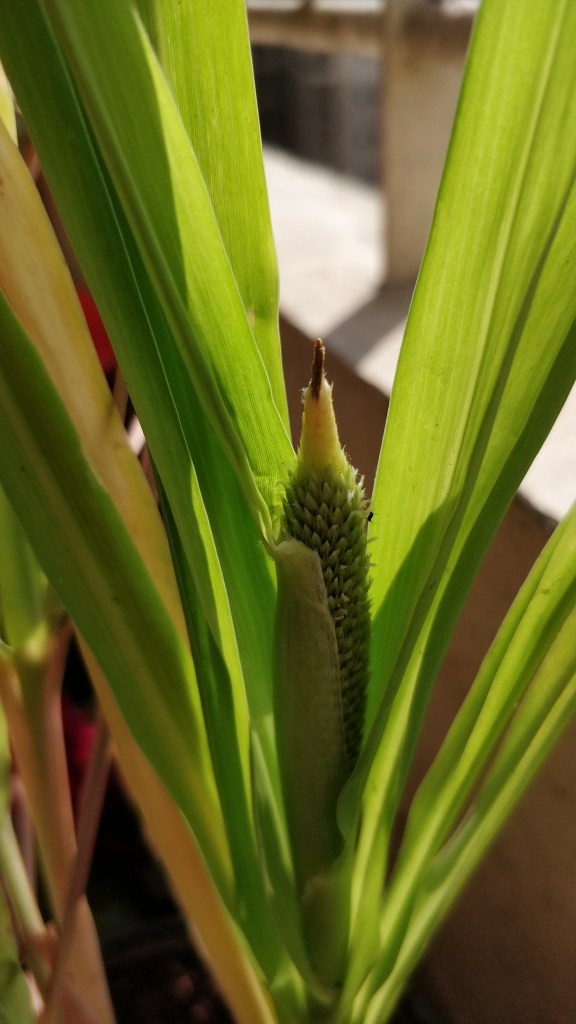
Got a surprise this morning to see a spadix on my lemon grass. I posted the photograph on a Facebook gardening group. When somebody asked me on the group how did this happen, I realized something was amiss. I did a Google Lens search and learnt that this compound flower is characteristic of the Sweet Flag plant. Fascinated, I immediately resorted to Google Search and dived into the world of Wikipedia. Lots of information later – https://en.m.wikipedia.org/wiki/Acorus_calamus – and curiosity piqued, I roamed around the Internet a bit and found more engrossing stuff, straight from the ancient times. Almost like a time capsule, the emergence of a spadix on a beautiful North Indian winter morning, transported me to Biblical times.

According to the https://christiananswers.net/dictionary/calamus.html, calmus is mentioned in the Holy Bible and is one of the ingredients of the Holy Anointing Oil (Exodus 30:23), one of the sweet scents (Song of Songs 4:14), and among the articles sold in the markets of Tyre (Ezek. 27:19)

The word designates an Oriental plant called the “sweet flag” and called “sweet cane” (Isaiah 43:24; Jeremiah 6:20). It’s used to make perfume.

It was not a native of Israel, but was imported from Arabia Felix or from India. It was probably what is now known in India by the name of “lemon grass” or “ginger grass,” the Andropogon schoenanthus.

The wonderful things we learn every day. Container gardening is so rewarding. But, now, I worry whether this to be consumed like lemon grass, brewed into tea, the way I do. A question that demands an extensive Google research and maybe some experts to respond on the gardening group, where I posted this photo that led to an amazing discovery.
Algae

Weeds

The Lure of Power

Globally, the lure of power is something I can never understand. Men of ripe age wanting authority over a divided people, in a raging pandemic, faltering economy, and destroyed environment. There must be something about power and the privileges that makes one want to embrace the worst possible stress and constant criticism and scrutiny, every single moment of their remaining life. Is power an addiction or is it just a way of life? Why is it so difficult to hand over the baton to another, with grace, dignity, and sharing of experience?

The desire to control people and land has been an age-old one, as ancient as the stars that make us up. There is always this one person dominating the family, the tribe, the clan, defining religion, molding the laws, having the final say in disputes, and eventually leading the men to war and conquest. All good till it lasts, till it serves the people but the desire to cling on to power only grows. Unsatiated, it invests on itself the Divine right. God has the power, so has man. Power is indestructible, so is the man wielding it?

Over the years, philosophies tried to evolve and keep power holders and religion or religious influences separate from each other. But we are still in a world where religion continues to influence politics, and so do so many other divisive factors. Does the power of “Power” lie in keeping people divided?

If you ask me, the real power is in leadership that embraces planning, guiding, listening, braving it out for the weaker, and taking everyone along. How difficult that can be? It can be if power gets into your head and makes you a megalomaniac. I was reading the other day that the more inferior a person feels, the stronger the desire for unbridled control.

A friend mentioned that she has noticed people craving more control as they grow older. Do they believe that power is the privilege of age? Who knows what goes in the minds of people who can only think in terms of subjugation of others and privilege for the self. One can only debate the adage that money cannot make one happy is true. Even with all the money in the world, the desire for controlling the souls and lives of people seems to give the highest rush.

As a down-to-earth person, with limited ambitions, but a compassionate view of life, which I seek to nourish, I find the power-race in our world disturbing, confusing, and absolutely incomprehensible. I think the corridors of power can be crowded and noisy with fans, followers, advisors, sycophants, but the real challenge is in deciphering whether you are lonely at the pinnacle. Every person at the peak of power need not take the lonely high seat. It takes just a step down to be a part of the people and lead the soul of the community, be the power of the people. Maybe this is Utopia and for all that we know Utopia is also not perfect!